Alaska’s U.S. Senate Race: Voters and the Law Support Local Control
Recent attention on Alaska’s U.S. Senate race has led national observers to raise questions about the ballot’s legality, including two candidates with similar names (incumbent U.S. Senator Daniel S. Sullivan and Alaska resident Daniel J. Sullivan) and potential election administration challenges. These concerns likely stem from unfamiliarity with the history of this race and the strengths of Alaska’s election process.
Alaska courts fully considered the legal issues concerning candidates with similar names months ago. Alaska’s checks and balances ensure election integrity and prevent potential voter confusion.
Alaska Courts Found No Legal Issue With Candidates Having Similar Names
After Daniel J. Sullivan filed a Declaration for Candidacy, challengers filed a complaint with the Alaska Division of Elections. The Division initially excluded Daniel J. Sullivan from the primary ballots. However, an Alaska superior court, ruling on Daniel J. Sullivan’s administrative appeal, overturned the Division’s decision. The court determined that Daniel J. Sullivan meets all qualifications under the federal Constitution and Alaska state statutes and nothing in state or federal law prevents him from running for the U.S. Senate.
The challengers sought an appeal to the Alaska Supreme Court. That Court quickly affirmed the superior court’s decision ordering Daniel J. Sullivan to be listed on the August primary ballot. It directed the Division of Elections to determine how to list both Sullivan candidates within the confines of existing Alaska ballot design law.
Alaskans don’t need help voting for their preferred candidates, and the State of Alaska has already done so by clearly distinguishing the candidates on this year’s ballot. – Sen. Lisa Murkowski
Alaska’s Election Process Contains Numerous Protections Against Voter Confusion
Following the Alaska Supreme Court’s order, the Division listed both Sullivan candidates on the August 18 primary ballot to clearly differentiate the two. The Division listed Senator Sullivan as “Sullivan, Dan S. (Registered Republican) Incumbent” while Daniel J. Sullivan was listed as simply “Sullivan, Daniel J.”, as pictured below. After the Division of Elections released the August sample ballot with the candidates listed in this manner, no one filed a challenge to how the candidates were designated on the ballot.
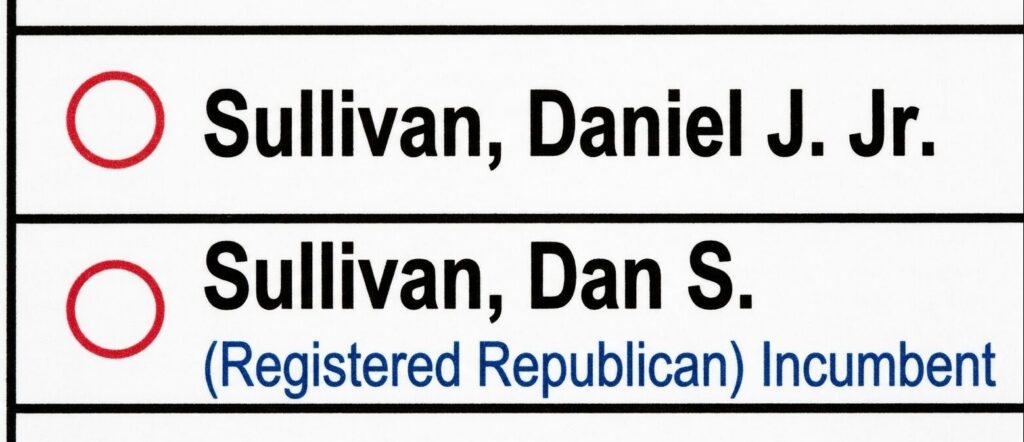
In Alaska’s system, the top four primary candidates advance to the general election ballot. Senator Sullivan finished second in August’s primary while Daniel J. Sullivan finished third. Thousands of Alaskans voted for Daniel J. Sullivan, placing him on the November ballot. For the November ballot, the Division is using designations for both candidates identical to those used for the August primary.
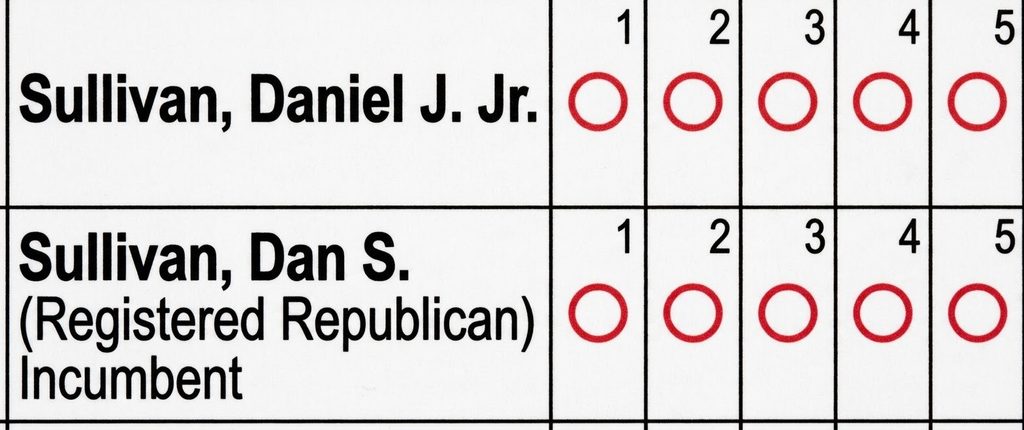
Under Alaska’s ranked-choice voting system for November’s election, voters may rank all candidates in their order of preference. Until one candidate is the top-ranked choice on a majority of ballots cast, the candidate with the fewest votes will be eliminated, and their votes will be reassigned to the remaining candidate each voter ranked highest. Thus, a voter can rank both Sullivan candidates 1-2 knowing that if one is eliminated, the other will then receive that voter’s vote.
Numerous checks and balances also ensure that final results accurately reflect voters’ preferences. For more information on these protections, see this Secure Democracy Foundation resource.
Alaska Voters Understand the Election Process and Know How to Ensure Votes Accurately Reflect Their Preferences
This year will be the third federal election Alaska conducts using its ranked-choice voting system. Alaska voters have previously elected a President and U.S. Senate and House members (as well as statewide officers) using the system. They are familiar with the process and understand how to cast ballots that properly reflect their preferences among candidates. In polling after the 2024 election, 84% of Alaska voters described the process as “simple.”
Alaska voters’ ability to understand a process observers might consider “complicated” should surprise no one. In 2010, Alaska became the first state in over 50 years to elect a U.S. Senator through a write-in campaign. Over 100,000 voters navigated the write-in process since they preferred Sen. Lisa Murkowski to any of the candidates listed on the ballot.
Alaska’s leaders have relied on the voters’ understanding of the process and the state’s interest in administering its own elections in several recent actions and statements rebuffing recent attempts by the federal government to intervene in the process:
- State and local election officials opposed a federal lawsuit filed by the U.S. Department of Justice (DOJ) seeking to prevent certification of the U.S. Senate race. A federal district court dismissed the suit on November 1, and the DOJ plans to appeal.
- Senator Lisa Murkowski sharply criticized the Justice Department for filing its lawsuit: “Alaskans don’t need any help voting for their preferred candidates, and the State of Alaska has already handled this by clearly distinguishing the candidates on this year’s ballot. The Department of Justice should never have filed this lawsuit.”
- After DOJ filed its lawsuit, Senator Sullivan reaffirmed his confidence in Alaska’s election process. When asked during a November 1 CNN interview if he would only accept the election results if he wins, Senator Sullivan responded, “No. I’m going to accept the election results.”
Voters and other interested parties should share the confidence in Alaska’s election process expressed by the state’s own leaders. Alaska voters know the difference between the candidates on their ballots and know how to vote for the ones they prefer. Last-minute federal intervention is unnecessary and unsupported by federal or state law.